
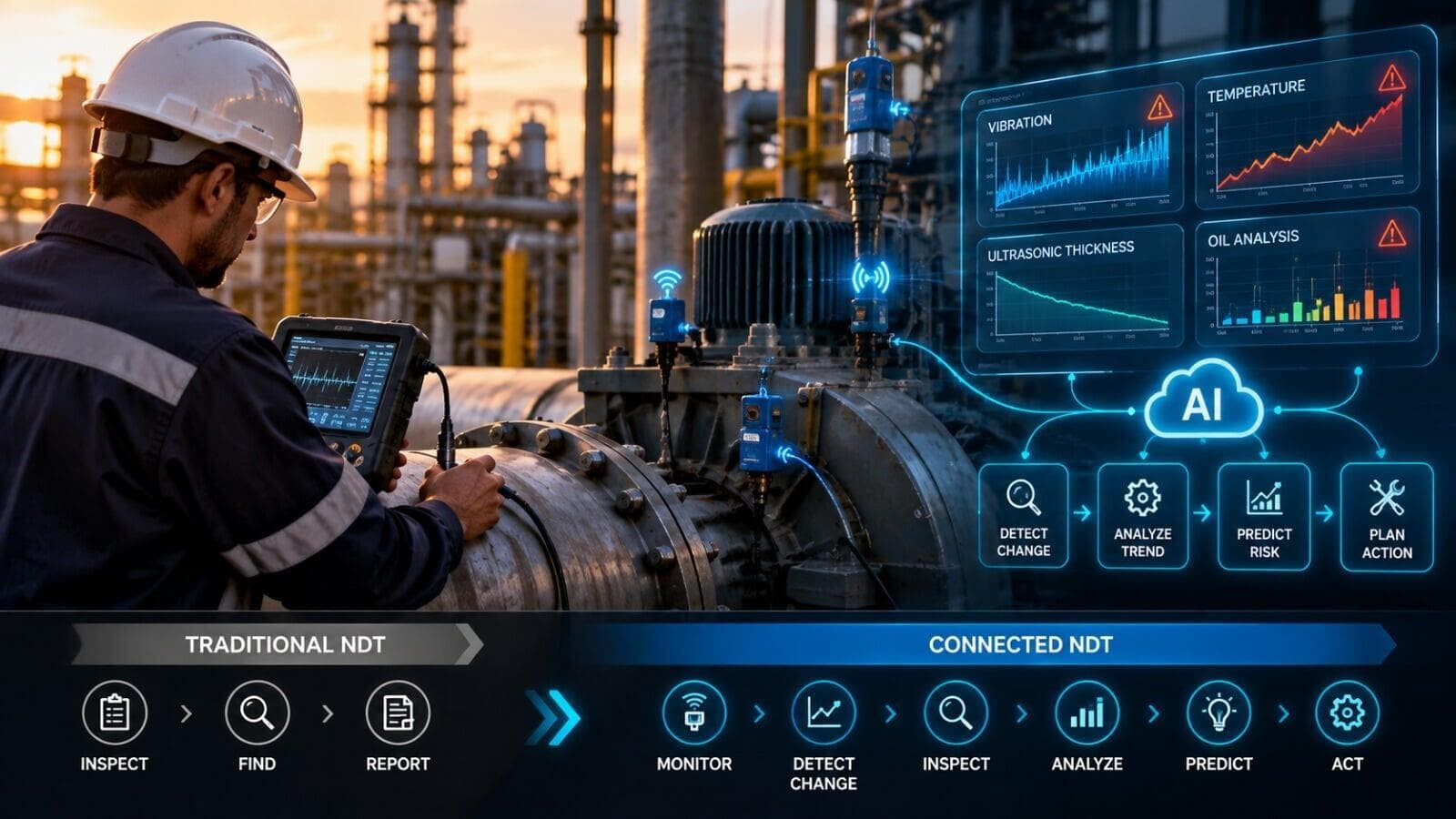
From periodic inspection to understanding how assets change over time
For decades, NDT has answered an essential question:
What is the condition of this asset today?
Ultrasonic testing, radiography, magnetic particle testing, eddy current testing, and other methods give inspectors valuable information about defects, degradation, and structural integrity at a specific moment.
But industrial reliability is increasingly asking another question:
How is the condition of this asset changing?
That shift is bringing condition monitoring and NDT closer together and creating new opportunities for inspection professionals.
From a Snapshot to a Trend
A traditional inspection provides a snapshot. Condition monitoring adds the timeline.
Instead of relying exclusively on inspections performed every few months or during scheduled shutdowns, sensors can continuously or periodically collect information such as:
Vibration
Temperature
Ultrasonic signals
Acoustic emissions
Wall thickness
Corrosion rates
Lubricant condition
Electrical behavior
An individual measurement is important, but its value often grows when compared with previous measurements. A small change may mean very little today. A consistent change over several weeks may indicate that degradation has begun.
That is where a trend becomes intelligence.
NDT and Condition Monitoring Are Complementary
Condition monitoring can help determine when a deeper NDT inspection is needed.
Imagine a permanently installed ultrasonic sensor detecting an increasing corrosion rate in a pipeline section. The monitoring system identifies the change. An NDT professional then applies the appropriate inspection technique to determine the location, extent, and severity of the degradation.
The workflow becomes:
Monitor → Detect Change → Inspect → Evaluate → Act
This approach allows organizations to focus inspection resources where the data indicates that something is changing.
The NDT Professional Becomes a Data Interpreter
This evolution also changes the inspector’s role. In addition to evaluating indications on an A-scan, radiograph, or thermographic image, NDT professionals may interpret months or years of asset behavior.
Was the wall-loss rate stable before it suddenly accelerated?
Did vibration increase after a maintenance intervention?
Was an acoustic emission event isolated, or is activity increasing?
Are temperature, vibration, and ultrasonic data pointing toward the same developing condition?
The value extends beyond collecting measurements. It lies in understanding what the measurements mean together.
Why Is This Happening Now?
Condition monitoring itself is not new. What has changed is the technology surrounding it.
Wireless sensors have become more practical. Industrial connectivity has improved. Cloud platforms can collect information from assets located miles apart, while edge computing can process information close to the equipment.
AI can also analyze large amounts of historical data to identify patterns and anomalies that may be difficult to recognize manually.
This creates an increasingly connected inspection environment:
Sensors → Data → Trends → AI Analysis → NDT Validation → Maintenance Decision
It is one of the most practical expressions of NDE 4.0.
More Data Does Not Automatically Mean Better Decisions
Installing hundreds of sensors is relatively easy. Knowing which signals matter is harder.
Operating conditions change. Equipment loads vary. Sensors can drift. Environmental conditions can influence measurements. An algorithm may identify an anomaly without understanding its engineering significance.
That is why human expertise remains essential. Technology can tell us something changed. Experienced NDT and reliability professionals must determine what changed, why it matters, and what to do next.
The Future of Inspection and Monitoring
The opportunity lies in integrating these capabilities:
Condition monitoring provides ongoing awareness.
NDT provides detailed characterization.
AI helps identify patterns.
Engineering determines significance.
Maintenance turns information into action.
Together, they can help industry move from finding defects toward understanding how assets are changing before defects become failures.
The question is no longer only, “Can we detect the defect?”
It is increasingly, “Can we recognize the change early enough to make a better decision?”
That is where condition monitoring and the future of NDT begin to meet.
NDT Tech Insights by NOMO NDT
Innovation for the Inspection Industry