
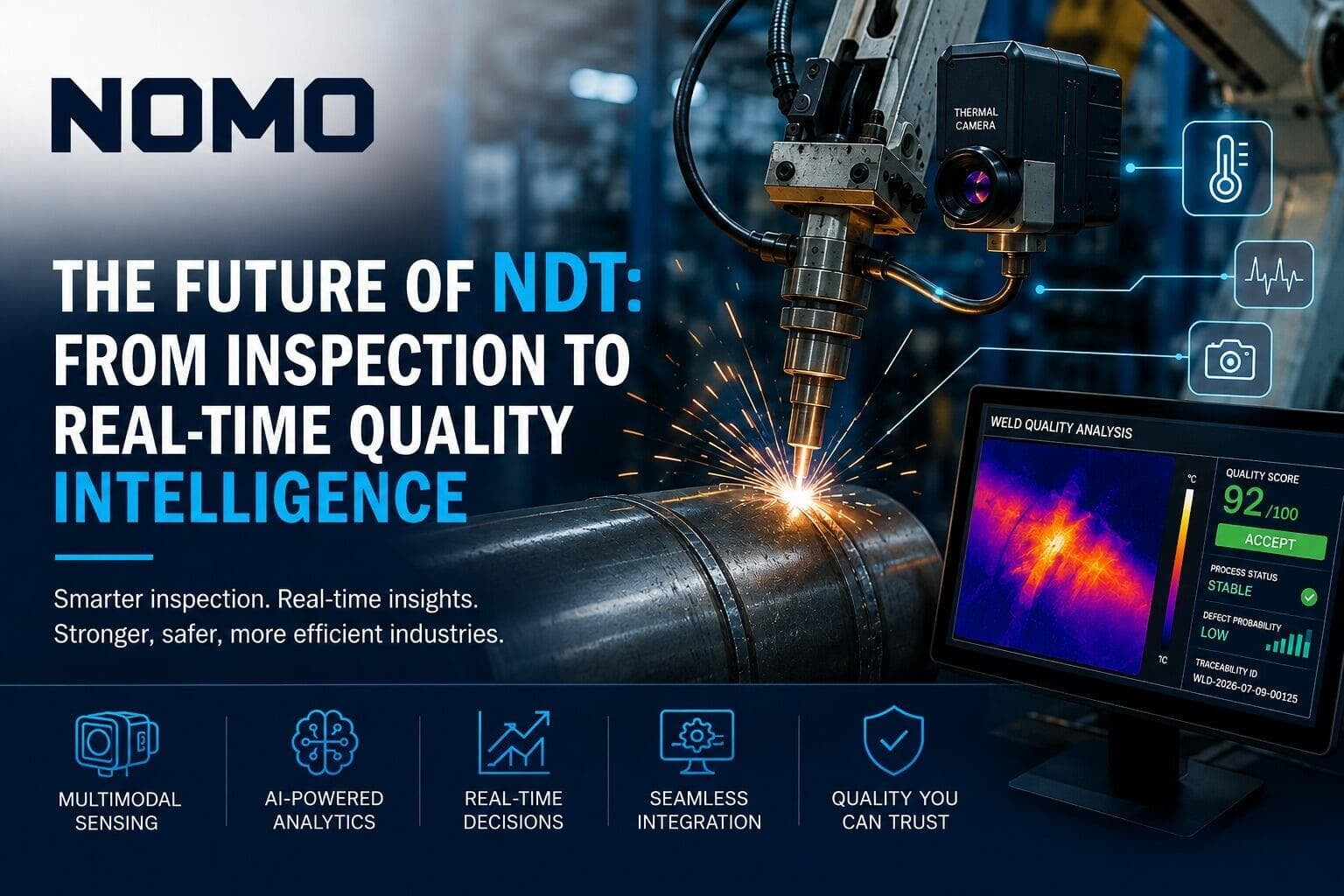
For decades, Non-Destructive Testing (NDT) has been essential for ensuring the safety and reliability of industrial assets. Traditionally, inspections are performed after manufacturing, allowing inspectors to detect defects before equipment enters service.
Today, however, manufacturers are shifting toward a smarter approach: preventing defects instead of simply finding them.
From Traditional Inspection to Intelligent Monitoring
As Industry 4.0 continues to transform manufacturing, NDT is evolving beyond conventional post-production inspections.
Modern production lines are increasingly incorporating real-time monitoring technologies, using thermal cameras, optical sensors, laser measurement, acoustic monitoring, and process data to evaluate quality while components are being manufactured.
This allows manufacturers to identify abnormal conditions immediately, reducing scrap, minimizing ework, and improving production efficiency.
AI Is Reshaping Industrial Inspection
Artificial Intelligence is becoming one of the biggest drivers of innovation in NDT.
By combining data from multiple sensors, AI can:
- Detect abnormal patterns
- Distinguish normal process variations from potential defects
- Generate real-time quality insights
- Improve traceability and reporting
Rather than reviewing large amounts of inspection data manually, engineers can make faster, more informed decisions based on intelligent analytics.
The Evolution Toward NDT 4.0
One of the defining characteristics of NDT 4.0 is connectivity
Inspection systems are increasingly integrated with Manufacturing Execution Systems (MES), Quality Management Systems (QMS), and industrial automation platforms, allowing inspection results to become part of a continuous flow of production data.
This connected approach helps manufacturers improve quality, optimize processes, and move closer to zero-defect manufacturing.
Beyond Welding
While many of today's in-process monitoring solutions have been developed for welding applications, the same concepts are expanding across numerous industries and manufacturing processes, including:
- Aerospace components
- Additive manufacturing
- Composite materials
- Pressure vessels
- Pipelines
- Structural health monitoring
As sensor technology and AI continue to advance, intelligent monitoring is becoming an important complement to traditional NDT methods.
Looking Ahead
Conventional inspection techniques such as Ultrasonic Testing, Radiographic Testing, Eddy Current, and Visual Inspection will continue to play a vital role in verifying product integrity.
However, the future of NDT is moving beyond final inspections. By combining advanced sensors, Artificial Intelligence, and connected manufacturing systems, organizations can identify quality issues earlier, reduce costs, and make better operational decisions.
At NOMO NDT, we continue to follow the latest innovations helping shape the next generation of smart, connected, and data-driven industrial inspection.