
NM0129800
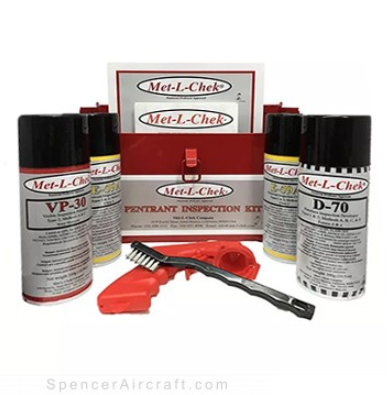
Penetrant Inspection Kit, 1 - VP-30, 2 - E-59A, 1 - D-70, Met-L-Chek SKU: 29800
Choose Quantity
Met-L-Chek — Penetrant Inspection Kit
Visible Dye Liquid Penetrant Testing Kit with VP-30 Penetrant, E-59A Cleaner/Remover, and D-70 DeveloperSKU: 29800
Overview
The Met-L-Chek Penetrant Inspection Kit is a complete visible dye liquid penetrant testing package designed for detecting surface-breaking discontinuities in suitable nonporous materials. It combines the essential materials required for surface preparation, penetrant application, excess penetrant removal, and indication development.
The kit includes one can of VP-30 visible red penetrant, two cans of E-59A cleaner/remover, and one can of D-70 nonaqueous developer. This configuration provides additional cleaner/remover for both initial surface preparation and controlled excess-penetrant removal during inspection.
VP-30 enters surface-breaking cracks, laps, seams, porosity, and other discontinuities through capillary action. After the excess penetrant is removed with E-59A and D-70 developer is applied, penetrant retained inside discontinuities bleeds back to the surface, producing visible red indications against the developer’s contrasting background.
SKU 29800 is suitable for field inspections, welding operations, fabrication facilities, maintenance departments, manufacturing plants, and industrial QA/QC programs.
What's Included
| Quantity | Item | Function |
|---|---|---|
| 1 | Met-L-Chek VP-30 Visible Penetrant | Enters and highlights surface-breaking discontinuities |
| 2 | Met-L-Chek E-59A Cleaner/Remover | Supports pre-cleaning and controlled removal of excess penetrant |
| 1 | Met-L-Chek D-70 Nonaqueous Developer | Produces a contrasting background and draws penetrant from discontinuities |
| 4 | Total Aerosol Cans | Complete visible penetrant inspection chemistry set |
Note: The exact aerosol-can volume is not specified in the supplied product information and should be confirmed before publication or ordering. Cleaning cloths, brushes, white-light meters, timers, marking tools, and personal protective equipment are not included unless specified separately.
Box Dimensions & Shipping Weight (Estimated)
| Parameter | Imperial |
|---|---|
| Length | 11.0 in |
| Width | 9.0 in |
| Height | 8.0 in |
| Dimensions (L × W × H) | 11.0 × 9.0 × 8.0 in |
| Weight | 5.0–7.0 lb |
Actual shipping dimensions and weight may vary depending on aerosol-can sizes, packaging materials, and distributor configuration.
Key Specifications
| Parameter | Details |
|---|---|
| Product Type | Visible dye penetrant inspection kit |
| Kit SKU | 29800 |
| Inspection Method | Liquid Penetrant Testing / PT |
| Penetrant Type | Visible red dye |
| Included Penetrant | VP-30 |
| Included Cleaner/Remover | E-59A |
| Included Developer | D-70 |
| Total Aerosol Cans | 4 |
| Removal Methods Supported | Method A and Method C, subject to procedure |
| Viewing Method | White-light inspection |
| Primary Use | Detection of surface-breaking discontinuities |
| Applicable Materials | Suitable clean, nonporous materials |
| Product Form | Ready-to-use aerosol products |
| Intended Environment | Field, shop, fabrication, maintenance, and QA/QC |
| Manufacturer | Met-L-Chek |
Kit Component Functions
| Inspection Step | Product | Purpose |
|---|---|---|
| Surface Preparation | E-59A | Helps remove oil, grease, dirt, and suitable surface contamination |
| Penetrant Application | VP-30 | Enters discontinuities open to the inspection surface |
| Excess Penetrant Removal | E-59A or controlled water washing | Removes background penetrant according to the selected procedure |
| Development | D-70 | Draws retained penetrant to the surface and creates a contrasting background |
| Evaluation | White-light inspection | Allows visible red indications to be located and interpreted |
| Post-Cleaning | E-59A | May assist with final cleaning when permitted by the procedure |
Performance Features
Complete Three-Part PT System
Includes the penetrant, cleaner/remover, and developer required for a standard visible dye penetrant inspection workflow.
Visible Red Indications
VP-30 produces red indications that can be evaluated under suitable white-light conditions without requiring a UV-A lamp.
Dual-Purpose Cleaner/Remover
E-59A can support initial surface cleaning and controlled Method C excess-penetrant removal.
Nonaqueous Developer
D-70 provides a contrasting developer coating that helps draw penetrant from surface-breaking discontinuities.
Two Cleaner/Remover Cans
The additional E-59A can supports surface preparation, penetrant removal, and repeated inspection work.
Portable Aerosol Configuration
All included materials are supplied in convenient aerosol form for field and localized inspection applications.
User-Friendly Design
Includes all primary chemical products required for visible penetrant testing
Ready-to-use aerosols require no mixing or dilution
Portable format fits into field inspection vehicles and tool kits
Visible indications can be evaluated without UV-A equipment
Two cleaner/remover cans support multiple inspection stages
Controlled aerosol application helps limit unnecessary chemical use
Suitable for localized inspections and difficult-access components
Individual products can be replaced separately after use
Practical for occasional inspections and routine maintenance work
Built for Industrial Environments
Designed for professional non-destructive testing
Suitable for field, workshop, fabrication, and maintenance use
Practical for welds, castings, forgings, and machined components
Supports inspection of installed or difficult-to-move equipment
Aerosol products simplify transport between inspection locations
Suitable for manufacturing and industrial QA/QC programs
Can be integrated into written penetrant-testing procedures
Pressurized containers require proper storage and handling
Inspection Procedure
1. Surface Preparation
Remove paint, scale, rust, coatings, and heavy contamination when required
Apply E-59A to the surface or to a clean, lint-free cloth
Wipe the inspection area until oil, grease, dirt, and removable residues are eliminated
Repeat cleaning when necessary
Allow the surface to dry completely before applying penetrant
2. Penetrant Application
Shake the VP-30 aerosol can as required
Apply a uniform coating over the complete inspection area
Ensure the surface remains adequately covered during the required dwell period
Allow the penetrant to remain on the surface for the time specified by the written procedure
3. Excess Penetrant Removal
For Method C solvent removal:
Remove the initial excess penetrant with a clean, dry, lint-free cloth
Apply a small amount of E-59A to a separate clean cloth
Wipe the surface gently until excessive red background is removed
Replace contaminated cloths as required
Avoid spraying remover directly onto the inspection surface unless permitted
Do not overclean or flush penetrant from discontinuities
For Method A water washing:
Use controlled water pressure and temperature as specified by the procedure
Avoid overwashing the component
Dry the surface as required before developer application
4. Developer Application
Shake the D-70 can thoroughly before and during use
Apply a thin, uniform developer coating
Avoid applying an excessively thick layer
Allow the developer to dry and remain on the surface for the specified development time
5. Inspection and Evaluation
Inspect the component under the required white-light intensity
Evaluate red indications against the developer background
Mark and document relevant indications
Apply the acceptance criteria specified by the governing procedure or standard
Perform post-inspection cleaning when required
Compatibility
Compatible with:
Visible dye liquid penetrant inspection
Method A water-washable procedures
Method C solvent-removable procedures
Suitable ferrous and nonferrous metals
Welded components
Castings and forgings
Machined parts
White-light inspection equipment
Visible-light meters
Field and laboratory PT programs
Industrial inspection documentation workflows
The kit should only be used on clean, nonporous surfaces. Compatibility should be evaluated before use on plastics, rubber, painted components, adhesives, composites, and other solvent-sensitive materials.
Ideal Applications
Weld inspection
Casting inspection
Forging evaluation
Machined-component inspection
Structural steel inspection
Pipeline and pressure-component inspection
Storage-tank maintenance
Automotive component testing
Aerospace maintenance applications
Fabrication QA/QC
Preventive maintenance
Field NDT service work
Surface-crack detection
Surface-breaking porosity detection
Leak-path detection
General industrial quality control
Typical Discontinuities Detected
The Met-L-Chek Penetrant Inspection Kit can help reveal discontinuities that are open to the inspection surface, including:
Cracks
Fatigue cracks
Grinding cracks
Heat-treatment cracks
Laps
Seams
Surface porosity
Cold shuts
Incomplete fusion open to the surface
Leak paths
Other surface-connected discontinuities
Liquid penetrant testing cannot detect discontinuities that do not break the surface.
Safety and Handling
Use all kit products only with adequate ventilation
Keep aerosol cans away from heat, sparks, flames, and ignition sources
Do not spray near hot surfaces or energized equipment
Avoid breathing aerosol mist, penetrant vapor, or solvent vapor
Wear appropriate gloves, eye protection, and protective clothing
Use respiratory protection when required by the workplace assessment
Do not puncture, crush, or incinerate aerosol cans
Protect containers from excessive heat and direct sunlight
Store cans upright in an approved aerosol-storage area
Keep all materials away from food and drinking areas
Follow the current Safety Data Sheet for each included product
Dispose of used cloths, residues, and containers according to applicable requirements
About Met-L-Chek
Met-L-Chek manufactures visible and fluorescent penetrants, developers, cleaners, removers, emulsifiers, magnetic particle materials, and related inspection chemistry for professional non-destructive testing. Its products support fabrication, manufacturing, aerospace, automotive, energy, maintenance, welding, and industrial quality-control applications.