
NM01291300001
Choose Quantity
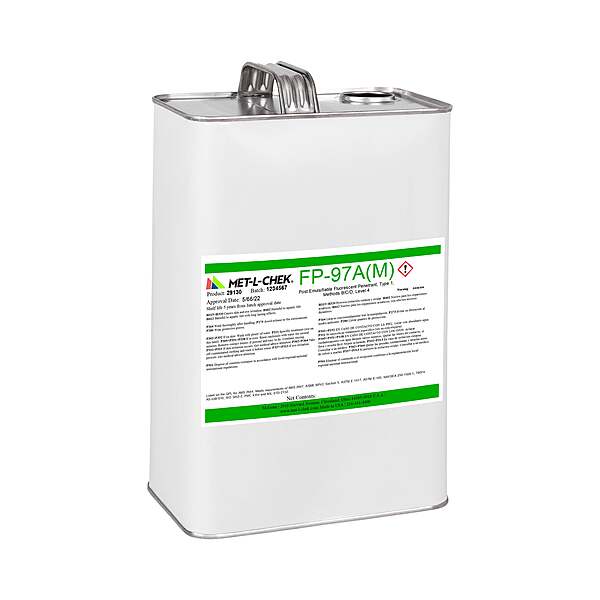
Met-L-Chek — FP-97A(M) Fluorescent PE Penetrant (Level 4, 1 gal / 3.7 L)
Ultra-High Sensitivity Fluorescent Penetrant for Methods B, C & D LPI Workflows SKU: 29130-0001Overview
Met-L-Chek FP-97A(M) is a fluorescent post-emulsifiable penetrant designed for ultra-high sensitivity liquid penetrant inspection applications. Classified as a Level 4 fluorescent penetrant, this product is intended for critical inspection work where very fine surface-breaking discontinuities must be detected with high reliability.
Designed for Methods B, C, and D workflows, FP-97A(M) supports lipophilic post-emulsifiable, solvent-removable, and hydrophilic post-emulsifiable penetrant inspection processes. Its fluorescent formulation produces bright indications under UV-A light, helping inspectors detect cracks, porosity, seams, laps, fatigue defects, and other open-to-surface flaws.
Supplied in a 1 gal / 3.7 L container, this product is ideal for aerospace, power generation, manufacturing, maintenance, and industrial NDT programs requiring dependable ultra-high sensitivity penetrant performance.
What's Included
| Item | Details |
|---|---|
| Fluorescent Penetrant | Met-L-Chek FP-97A(M) PE penetrant |
| Sensitivity Level | Level 4 |
| Container Size | 1 gal / 3.7 L |
Box Dimensions & Shipping Weight (Estimated)
| Parameter | Imperial |
|---|---|
| Length | 8.0 in |
| Width | 8.0 in |
| Height | 12.0 in |
| Dimensions (L × W × H) | 8.0 × 8.0 × 12.0 in |
| Weight | 9.0 lb |
Key Specifications
| Parameter | Details |
|---|---|
| Product Type | Fluorescent PE penetrant |
| Product Name | FP-97A(M) |
| Inspection Type | Fluorescent / Type I |
| Sensitivity Level | Level 4 |
| Methods | B, C, and D |
| Container Size | 1 gal / 3.7 L |
| Application | Liquid penetrant inspection |
| Manufacturer | Met-L-Chek |
| SKU | 29130-0001 |
Performance Features
Level 4 Sensitivity
Designed for ultra-high sensitivity inspection of very fine surface-breaking defects.
Methods B, C & D Compatibility
Supports post-emulsifiable and solvent-removable fluorescent penetrant workflows.
Bright Fluorescent Indications
Provides strong visibility under UV-A light for accurate defect detection.
Critical Inspection Support
Ideal for demanding applications requiring high confidence in flaw detection.
User-Friendly Application
- Suitable for controlled fluorescent LPI processes
- Practical 1 gal / 3.7 L size for shop, lab, and field use
- Supports multiple penetrant removal methods
- Designed for professional NDT inspection workflows
- Compatible with approved emulsifiers, removers, and developers
Built for Industrial Environments
- Reliable performance in demanding inspection applications
- Suitable for aerospace and critical component inspection programs
- Practical for production and maintenance environments
- Designed for repeated use in professional NDT workflows
Compatibility
Compatible with:
- Fluorescent liquid penetrant inspection workflows
- Method B lipophilic emulsifier processes
- Method C solvent-removable processes
- Method D hydrophilic emulsifier processes
- UV-A inspection lamps
- Compatible Met-L-Chek cleaners, emulsifiers, and developers
Ideal Applications
- Fluorescent liquid penetrant inspection
- Aerospace component inspection
- Very fine crack detection
- Critical surface defect evaluation
- Weld, casting, and forging inspection
- Power generation maintenance
- Manufacturing quality control
- Industrial NDT inspection programs
About Met-L-Chek
Met-L-Chek is a leading manufacturer of liquid penetrant and magnetic particle inspection consumables, providing reliable NDT solutions for professional inspection environments. Their products are trusted for sensitivity, consistency, and dependable defect detection.