
NM01SU2M3A3Dx6.4-105S
Choose Quantity
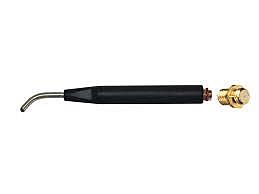
OKO-NDT — Eddy Current 45-Degree Angle Shaft Surface Probe
SU2M3A3Dx6.4-105S | 2 MHz | Bridge Type | Single Shielded | Non-Ferrous MaterialsSKU: SU2M3A3Dx6.4-105S
Overview
The OKO-NDT SU2M3A3Dx6.4-105S is a high-frequency, 45-degree angle shaft (L-shaped) eddy current surface probe engineered for precision detection of surface-breaking discontinuities in electrically conductive non-ferrous materials — including aluminum alloys, titanium, copper, brass, and austenitic stainless steels. Manufactured by OKOndt GROUP, this probe belongs to the SU series of absolute Bridge-type surface probes and is specifically designed for inspection of spots with complicated access or parts with protruding elements where a straight probe cannot maintain consistent surface contact.
Operating at a center frequency of 2 MHz, the SU2M3A3Dx6.4-105S delivers the high sensitivity and fine spatial resolution required for detection of tight surface cracks, fatigue cracks, corrosion pitting, and other near-surface discontinuities in thin-section and precision components. The 45-degree sensing element angle combined with the 6.4 mm drop length allows the probe to reach into recesses, fillets, radii, and other geometrically complex areas that are inaccessible to standard straight probes — without sacrificing sensitivity or lift-off stability.
Designation Code — Decoded
The full designation SU2M3A3Dx6.4-105S is an OKOndt GROUP standardized probe designation code. Each element describes a specific physical and electrical characteristic of the probe:
| Code Element | Meaning |
|---|---|
| SU | Surface probe — designed for surface flaw detection |
| 2M | Center frequency: 2 MHz |
| 3A | Drop angle of sensing element to probe axis: 45° |
| 3D | Probe tip diameter: 3 mm |
| x6.4 | Drop length: 6.4 mm |
| -105 | Probe handle length: 105 mm (4.1 in) — standard length |
| S | Shielded — ferrite shielded sensing element to reduce edge effects and lift-off noise |
Key Specifications
| Parameter | Details |
|---|---|
| Designation | SU2M3A3Dx6.4-105S |
| Probe Type | Absolute, Bridge type — single shielded |
| Sensing Element Angle | 45° to the probe handle axis (L-shaped / angle shaft) |
| Center Frequency | 2 MHz |
| Tip Diameter | 3 mm (0.12 in) |
| Drop Length | 6.4 mm (0.25 in) |
| Handle Length | 105 mm (4.1 in) — standard; custom lengths available on request |
| Connector | Triax Lemo / Fischer |
| Compatible Materials | Non-ferrous (NFe) — aluminum, titanium, copper, brass, austenitic stainless steel |
| Shielding | Shielded (S) — ferrite core shielding |
| Circuit Type | Bridge (B) — absolute measurement |
Box Dimensions & Shipping Weight (Estimated)
| Parameter | Metric | Imperial |
|---|---|---|
| Length | 152 mm | 6.0 in |
| Width | 76 mm | 3.0 in |
| Height | 51 mm | 2.0 in |
| Dimensions (L × W × H) | 152 × 76 × 51 mm | 6.0 × 3.0 × 2.0 in |
| Weight | 0.20 kg | 0.44 lb |
Dimensions and weight are estimates based on typical packaging for eddy current probe units of this class. Please verify with your freight forwarder prior to shipping.
45-Degree Angle Design — Access Where Straight Probes Cannot
The defining physical characteristic of the SU2M3A3Dx6.4-105S is its 45-degree (L-shaped) angle between the sensing element tip and the handle axis. This geometry enables inspection of surface locations that are completely inaccessible to standard straight probes — including:
- Fillet radii and corner features — where straight probes cannot maintain flat surface contact
- Fastener hole countersinks and edges — critical fatigue crack initiation sites in aerospace structures
- Component recesses and slots — narrow grooves and channels where the probe body would collide with surrounding structure using a straight configuration
- Parts with protruding elements — brackets, ribs, flanges, and similar features that obstruct straight probe access to the inspection area
- Blade root and disk slot inspection — common in gas turbine and compressor maintenance
The 6.4 mm drop length provides sufficient clearance between the probe handle and the inspection surface to navigate moderate surface obstructions, while keeping the sensing element close enough to the handle body for stable, controlled manipulation.
2 MHz Frequency — High Resolution Surface Detection
At 2 MHz, the SU2M3A3Dx6.4-105S operates in the high-frequency range of the OKO-NDT SU probe series — providing the following performance advantages:
- High spatial resolution — the 2 MHz frequency limits the eddy current field penetration depth, concentrating sensitivity at and immediately below the surface. This makes the probe highly effective at detecting tight, narrow surface cracks that lower frequency probes might miss due to reduced sensitivity to fine defects
- Non-ferrous materials optimization — the 2 MHz center frequency is matched to the electrical conductivity range of non-ferrous materials (aluminum, titanium, copper, brass, austenitic stainless steels), ensuring maximum sensitivity across this material family
- Reduced noise from subsurface structure — the shallow penetration depth minimizes interference from subsurface geometry, fastener holes, and material microstructure that can mask surface indications at lower frequencies
| Frequency Range | Typical Use | Penetration Depth |
|---|---|---|
| 200 – 500 kHz | Deeper defects, ferrous and non-ferrous | Greater |
| 2 MHz — This Probe | Surface cracks, non-ferrous materials | Shallow — maximum surface sensitivity |
| 6 MHz | Very fine surface cracks, thin sections | Very shallow |
Shielded Design — Reduced Edge Effects and Lift-Off Noise
The "S" (Shielded) designation indicates that this probe incorporates a ferrite shield around the sensing coil. The shielding confines the eddy current field to the area directly beneath the probe tip — delivering two important performance benefits:
- Reduced edge effects — the confined field allows the probe to inspect much closer to edges, holes, fasteners, and geometric transitions without generating false signals from nearby features. This is especially important in aerospace inspection where components have closely spaced fastener holes and complex geometry
- Reduced lift-off sensitivity — the ferrite shield reduces the probe's sensitivity to small variations in probe-to-surface distance (lift-off), improving signal stability and reducing false calls during scanning on slightly rough or uneven surfaces
Bridge Circuit — Absolute Measurement
The Bridge (B) circuit type means this probe operates as an absolute single-coil measurement system — measuring the total impedance of the sensing coil as a direct function of the material properties and the presence of discontinuities beneath the tip. Key characteristics of the absolute Bridge configuration:
- Direct defect response — any discontinuity beneath the probe tip produces an immediate, direct signal change proportional to the defect's effect on eddy current flow
- Sensitive to gradual property changes — unlike differential probes which cancel slowly varying signals, the absolute Bridge probe responds to both sharp discontinuities and gradual material property variations
- Simpler signal interpretation — the absolute impedance plane signal is straightforward to interpret, making this probe configuration well suited to both experienced operators and those newer to eddy current testing
Compatible Instruments
The SU2M3A3Dx6.4-105S probe is compatible with any eddy current flaw detector equipped with a Triax Lemo or Fischer connector input operating in the 2 MHz frequency range, including:
- OKOndt GROUP Eddycon C
- OKOndt GROUP Eddycon CL
- Olympus (Nortec) series eddy current instruments
- Zetec, GE Inspection, and other major manufacturer instruments with Triax Lemo / Fischer inputs
OKO-NDT SU Series — 45-Degree Angle Shaft Probe Family
The SU2M3A3Dx6.4-105S is part of a broader family of OKO-NDT 45-degree angle shaft surface probes covering a wide range of frequencies, tip diameters, and drop lengths:
| Designation | Tip Ø | Drop Length | Frequency | Material |
|---|---|---|---|---|
| SU200K3A4.5Dx6.4-105 B | 4.5 mm | 6.4 mm | 200 kHz | Fe / NFe |
| SU500K3A3Dx6.4-105 B | 3 mm | 6.4 mm | 500 kHz | Fe / NFe |
| SU500K3A4.5Dx6.4-105 B | 4.5 mm | 6.4 mm | 500 kHz | Fe / NFe |
| SU500K3A4.5Dx12.7-105 B | 4.5 mm | 12.7 mm | 500 kHz | Fe / NFe |
| SU2M3A2.5Dx2.7-105 B | 2.5 mm | 2.7 mm | 2 MHz | NFe |
| SU2M3A3Dx2.7-105 B | 3 mm | 2.7 mm | 2 MHz | NFe |
| SU2M3A3Dx6.4-105S — This Product | 3 mm | 6.4 mm | 2 MHz | NFe |
| SU2M3A3Dx12.7-105 B | 3 mm | 12.7 mm | 2 MHz | NFe |
| SU6M3A2.5Dx6.4-105 B | 2.5 mm | 6.4 mm | 6 MHz | NFe |
Custom probe lengths (other than the standard 105 mm) are available on request from OKOndt GROUP.
Ideal Applications
- Fatigue crack detection in aluminum and titanium aerospace structural components
- Fastener hole edge and countersink inspection for cracks in aircraft skins and structures
- Fillet radius and corner feature inspection on machined components
- Surface crack detection in austenitic stainless steel welds and heat-affected zones
- Inspection of recesses, slots, and geometrically complex features inaccessible to straight probes
- Gas turbine blade root and disk slot inspection
- Quality control of non-ferrous castings, forgings, and machined parts
- In-service inspection of aircraft maintenance stations, MRO facilities, and aerospace overhaul shops
About OKOndt GROUP
OKOndt GROUP is an internationally recognized group of companies with over 30 years of experience in researching, developing, and manufacturing non-destructive testing equipment for industrial customers worldwide. The OKOndt eddy current probe range covers the full spectrum of industrial ECT applications — from standard surface probes and bolt hole probes to custom-engineered solutions for specific inspection geometries and requirements.