
NM01290450005
Choose Quantity
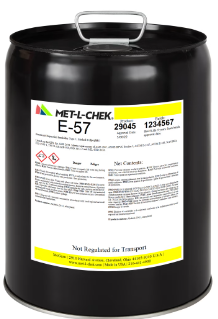
Met-L-Chek — E-57 Lipophilic Emulsifier
Method B Lipophilic Emulsifier for Post-Emulsifiable Liquid Penetrant Inspection, 5 gal / 18.9 L
SKU: 29045-0005
Overview
Met-L-Chek E-57 is a lipophilic emulsifier designed for Method B post-emulsifiable liquid penetrant inspection. It is used after the penetrant dwell period to make excess oil-based penetrant on the component surface removable with water.
Unlike water-washable penetrants, Method B post-emulsifiable penetrants require a separate emulsification step. E-57 interacts with the excess penetrant on the surface, allowing it to be removed during the subsequent controlled water rinse while penetrant retained inside surface-breaking discontinuities remains available for development and inspection.
The 5-gallon / 18.9 L bulk container is well suited for immersion tanks, dedicated penetrant-processing stations, aerospace inspection departments, manufacturing facilities, maintenance operations, and other NDT environments using Method B penetrant systems.
What's Included
| Item | Details |
|---|---|
| Lipophilic Emulsifier | Met-L-Chek E-57 |
| Product Type | Penetrant emulsifier |
| Emulsifier Classification | Lipophilic |
| Penetrant Removal Method | Method B |
| Container Type | Bulk container / pail |
| Container Size | 5 gal / 18.9 L |
| Primary Function | Emulsification of excess post-emulsifiable penetrant |
| Inspection Method | Liquid Penetrant Testing / PT |
| Manufacturer | Met-L-Chek |
| SKU | 29045-0005 |
Note: Penetrant, developer, cleaner, immersion tank, rinse equipment, timers, UV-A equipment, and other inspection accessories are not included unless specified separately.
Box Dimensions & Shipping Weight (Estimated)
| Parameter | Imperial |
|---|---|
| Length | 14.0 in |
| Width | 14.0 in |
| Height | 16.0 in |
| Dimensions (L × W × H) | 14.0 × 14.0 × 16.0 in |
| Estimated Shipping Weight | 45–50 lb |
Actual dimensions and weight may vary depending on the container and protective packaging.
Key Specifications
| Parameter | Details |
|---|---|
| Product Type | Lipophilic emulsifier |
| Model | E-57 |
| Inspection Method | Liquid Penetrant Testing / PT |
| Removal Method | Method B |
| Emulsifier Type | Lipophilic |
| Product Form | Ready-to-use liquid |
| Container Size | 5 gal / 18.9 L |
| Primary Function | Makes excess post-emulsifiable penetrant water removable |
| Application Stage | After penetrant dwell and before water rinse |
| Typical Application | Immersion or other approved Method B technique |
| Compatible Penetrant Type | Approved post-emulsifiable penetrants |
| Intended Environment | Production, laboratory, aerospace, manufacturing, and QA/QC |
| Manufacturer | Met-L-Chek |
| SKU | 29045-0005 |
Method B Inspection Sequence
| Step | Process |
|---|---|
| 1 | Pre-clean and dry the inspection surface |
| 2 | Apply approved post-emulsifiable penetrant |
| 3 | Allow the specified penetrant dwell time |
| 4 | Drain excess penetrant as required |
| 5 | Apply or immerse the component in E-57 emulsifier |
| 6 | Control emulsification time carefully |
| 7 | Stop emulsification with the specified water rinse |
| 8 | Remove emulsified surface penetrant |
| 9 | Dry the component when required |
| 10 | Apply an approved developer |
| 11 | Allow the required development time |
| 12 | Inspect under the specified viewing conditions |
Precise dwell, emulsification, rinse, drying, and development times should follow the approved written procedure.
Performance Features
Method B Lipophilic Emulsification
Designed specifically for post-emulsifiable penetrant systems using the Method B removal process.
Controlled Surface Penetrant Removal
Helps make excess penetrant on the component surface water removable while preserving penetrant retained in discontinuities when process times are properly controlled.
Ready-to-Use Formulation
Designed for direct use without routine dilution, simplifying Method B process control.
Suitable for Immersion Processing
Well suited for dedicated emulsifier tanks and production penetrant inspection lines.
Bulk 5-Gallon Supply
Provides a practical quantity for inspection departments performing regular Method B penetrant testing.
Supports High-Sensitivity PT Workflows
Method B processing is commonly selected where careful penetrant-removal control is required.
Lipophilic Emulsifier Function
E-57 works by interacting directly with the excess penetrant remaining on the inspection surface.
During the emulsification step:
The emulsifier contacts the surface penetrant
The penetrant and emulsifier begin to form a water-removable mixture
Emulsification progresses inward from the exposed penetrant surface
The process is stopped after the specified contact time
Controlled water rinsing removes the emulsified surface penetrant
Penetrant trapped inside surface-breaking discontinuities remains available to form indications
Because emulsification continues as long as contact is maintained, process timing is critical.
Method B Advantages
Method B post-emulsifiable penetrant systems can provide several advantages for suitable inspection programs:
Controlled removal of excess penetrant
Reduced risk of excessive background when properly processed
Suitable for high-sensitivity penetrant systems
Useful for production inspection lines
Supports repeatable process control
Allows penetrant and removal stages to be managed separately
Suitable for demanding aerospace and manufacturing inspection programs
Can provide excellent indication definition when properly applied
User-Friendly Design
Ready-to-use formulation
No routine dilution required
Suitable for bulk immersion applications
Can be integrated into established Method B processing lines
Supports repeatable emulsification procedures
Five-gallon container is practical for tank replenishment
Suitable for dedicated inspection stations
Can be transferred using compatible chemical-handling equipment
Built for Industrial Inspection Environments
Designed for professional liquid penetrant testing
Suitable for manufacturing and aerospace QA/QC
Practical for production inspection lines
Supports inspection of complex manufactured components
Suitable for castings, forgings, machined parts, and other nonporous components
Can be used in dedicated penetrant-processing tanks
Bulk format supports regular production use
Intended for controlled Method B inspection procedures
Application Guidelines
Before Emulsification
Clean and dry the component thoroughly
Apply an approved post-emulsifiable penetrant
Allow the specified penetrant dwell time
Drain excess penetrant where required
Do not water-rinse the penetrant before applying the lipophilic emulsifier unless specifically permitted by the procedure
Emulsifier Application
E-57 may be applied according to the approved process, typically by:
Immersion
Controlled flow-on application
Other approved Method B application techniques
Maintain complete and uniform contact with the required inspection surface.
Emulsification Time
Emulsification time is one of the most critical variables in Method B penetrant testing.
If the time is too short:
Excess background penetrant may remain
Rinsing may be difficult
Inspection sensitivity may be affected by excessive background
If the time is too long:
Penetrant may be removed from shallow discontinuities
Relevant indications may become weaker
Inspection sensitivity may be reduced
Use the emulsification time specified by the approved written procedure and maintain consistent process timing between components.
Water Rinsing
After the specified emulsification period:
Begin water rinsing promptly
Maintain the required water pressure
Maintain the specified water temperature
Direct the rinse to remove emulsified surface penetrant
Avoid excessive rinse duration
Monitor the component for adequate background removal
Stop rinsing when the required surface condition is achieved
Dry the component as required before developer application
Water-rinse parameters should be controlled according to the inspection procedure.
Compatibility
Compatible with:
Approved post-emulsifiable penetrants
Method B liquid penetrant inspection systems
Compatible fluorescent penetrant systems
Approved developers
UV-A inspection equipment when used with fluorescent penetrants
Suitable penetrant-processing tanks
Compatible pumps and transfer equipment
Rinse stations
Drying ovens or drying equipment when applicable
Suitable nonporous metallic materials
The penetrant, emulsifier, developer, cleaner, and processing parameters should be qualified for use together under the applicable inspection procedure.
Ideal Applications
Method B penetrant inspection
Aerospace component inspection
Turbine and engine component testing
Precision casting inspection
Forging evaluation
Machined-component inspection
Automotive manufacturing
Power-generation component inspection
Production penetrant lines
Fabrication QA/QC
High-sensitivity surface inspection
Maintenance and overhaul programs
Surface-crack detection
Surface-breaking porosity detection
Industrial quality-control programs
Typical Discontinuities Detected
When used as part of a complete penetrant system, Method B inspection can help detect surface-breaking discontinuities such as:
Fatigue cracks
Grinding cracks
Heat-treatment cracks
Laps
Seams
Surface porosity
Cold shuts
Surface-connected lack of fusion
Leak paths
Other discontinuities open to the inspection surface
Liquid penetrant testing does not detect discontinuities that are completely below the surface.
Bulk Handling and Storage
For the 5-gallon container:
Store in a cool, dry, well-ventilated area
Keep the container securely closed when not in use
Prevent contamination with penetrant, water, dirt, or other chemicals
Use chemically compatible pumps and transfer equipment
Clearly identify secondary containers
Do not return contaminated emulsifier to the original container
Maintain dedicated equipment where practical
Protect from excessive heat and direct sunlight
Follow facility procedures for chemical inventory and spill containment
Process Control
Routine process monitoring is important in Method B penetrant systems.
Inspection programs may include checks for:
Emulsifier contamination
Water contamination
Penetrant carryover
Process temperature
Emulsification time
Rinse effectiveness
System performance using applicable reference standards
Overall penetrant-system sensitivity
Process-control frequency and acceptance criteria should follow the governing procedure and applicable inspection requirements.
Safety and Handling
Use with adequate ventilation
Avoid prolonged skin and eye contact
Wear suitable gloves, eye protection, and protective clothing
Use respiratory protection when required by workplace assessment
Keep the container closed when not in use
Prevent spills and uncontrolled releases
Use appropriate material-handling equipment for a full 5-gallon container
Keep transfer equipment clean and chemically compatible
Follow the current Safety Data Sheet and workplace procedures
Dispose of contaminated product and waste according to applicable requirements
About Met-L-Chek
Met-L-Chek manufactures visible and fluorescent penetrants, emulsifiers, developers, cleaners, removers, magnetic particle materials, and related inspection chemistry for professional non-destructive testing. Its products support aerospace, automotive, fabrication, manufacturing, maintenance, energy, and industrial quality-control applications.