
NM01T1040000
Choose Quantity
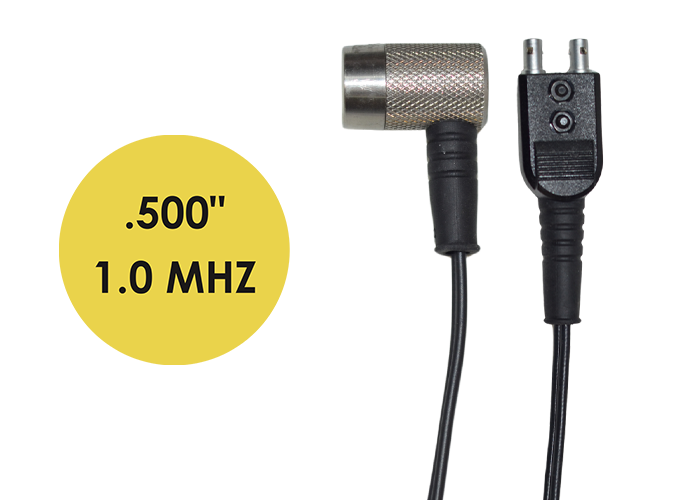
Dakota NDT — T-104-0000 Dual-Element Transducer
1.0 MHz, 1/2 in Dual-Element Ultrasonic Transducer, Potted Side Entry — for HDPE, Fiberglass, and Difficult-to-Penetrate Materials
SKU: T-104-0000
Overview
The Dakota NDT T-104-0000 is a 1.0 MHz dual-element ultrasonic transducer designed for thickness measurement applications involving materials that are difficult to penetrate ultrasonically, including HDPE, fiberglass, thick sections, and other highly attenuative materials.
Its relatively low 1.0 MHz operating frequency provides greater acoustic penetration than higher-frequency probes, helping improve signal transmission through materials that absorb or scatter ultrasonic energy more strongly.
The transducer uses a 1/2 in dual-element configuration with separate transmitting and receiving elements. This design supports pulse-echo thickness measurement while improving performance on surfaces where corrosion, material structure, surface roughness, or acoustic attenuation can make conventional measurements more difficult.
A permanently potted side-entry cable provides a secure probe connection while routing the cable away from the top of the transducer for convenient positioning during field and industrial inspections.
What's Included
| Item | Details |
|---|---|
| Ultrasonic Transducer | Dakota NDT T-104-0000 |
| Transducer Type | Dual element |
| Nominal Frequency | 1.0 MHz |
| Element / Contact Size | 1/2 in |
| Cable Configuration | Potted / fixed |
| Cable Entry | Side |
| Primary Application | Thickness measurement on difficult-to-penetrate materials |
| Typical Materials | HDPE, fiberglass, thick or attenuative materials |
| Inspection Method | Ultrasonic Testing / UT |
| Manufacturer | Dakota NDT |
| SKU | T-104-0000 |
Note: Ultrasonic thickness gauge, couplant, calibration standards, adapters, and other accessories are not included unless specified separately.
Box Dimensions & Shipping Weight (Estimated)
| Parameter | Imperial |
|---|---|
| Length | 8.0 in |
| Width | 5.0 in |
| Height | 3.0 in |
| Dimensions (L × W × H) | 8.0 × 5.0 × 3.0 in |
| Weight | 1.0 lb |
Actual shipping dimensions and weight may vary depending on cable length and protective packaging.
Key Specifications
| Parameter | Details |
|---|---|
| Product Type | Dual-element ultrasonic transducer |
| Model | T-104-0000 |
| Nominal Frequency | 1.0 MHz |
| Element Size | 1/2 in |
| Element Configuration | Separate transmitting and receiving elements |
| Cable Style | Potted / permanently attached |
| Cable Entry Position | Side |
| Primary Use | Thickness measurement of attenuative materials |
| Typical Materials | HDPE, fiberglass, composites, thick metals, and other suitable materials |
| Typical Inspection Mode | Pulse-echo ultrasonic thickness gauging |
| Inspection Method | Ultrasonic Testing / UT |
| Intended Environment | Field, plant, fabrication, maintenance, and QA/QC |
| Manufacturer | Dakota NDT |
| SKU | T-104-0000 |
Performance Features
1.0 MHz Low-Frequency Operation
Provides increased ultrasonic penetration compared with higher-frequency transducers, making it particularly useful for materials that strongly attenuate or scatter sound.
Suitable for HDPE Inspection
The lower operating frequency supports thickness measurements on suitable high-density polyethylene components where higher-frequency probes may produce weak or unstable back-wall echoes.
Suitable for Fiberglass Applications
Can be used on compatible fiberglass and composite structures where material composition and internal structure make ultrasonic penetration challenging.
Dual-Element Construction
Separate transmit and receive elements support reliable pulse-echo measurements while improving near-surface response.
1/2 in Contact Size
Provides a stable contact area and useful acoustic energy for difficult inspection conditions.
Potted Side-Entry Cable
Provides a permanently secured probe connection with convenient cable routing for field and maintenance applications.
Why Use a 1.0 MHz Transducer?
Lower-frequency ultrasonic probes are often preferred when acoustic penetration is more important than extremely fine resolution.
Potential advantages include:
Improved penetration through HDPE
Better signal transmission through fiberglass
Improved response on attenuative materials
Greater penetration through thicker sections
Improved performance on coarse or heterogeneous materials
Better tolerance of rough or degraded surfaces
Stronger back-wall echoes in difficult inspection conditions
Useful performance where higher-frequency probes lose signal strength
The exact performance depends on material type, thickness, density, fiber orientation, surface condition, temperature, couplant, and instrument configuration.
Material Compatibility
The T-104-0000 may be suitable for thickness measurement of:
HDPE
Fiberglass
Fiber-reinforced plastics
Certain composite materials
Thick carbon steel
Stainless steel
Cast metals
Coarse-grained materials
Corroded metallic components
Attenuative industrial materials
Other materials capable of transmitting ultrasonic energy
Because fiberglass and composite materials can vary considerably in construction, resin content, fiber orientation, and internal structure, calibration should be performed using a representative reference sample whenever possible.
User-Friendly Design
Low frequency supports difficult inspection conditions
1/2 in contact area provides stable coupling
Dual-element construction supports reliable thickness gauging
Side-entry cable improves handling in suitable inspection areas
Potted design provides a secure fixed connection
Suitable for field and plant inspection programs
Practical for spot measurements and repeated monitoring
Can be integrated with compatible Dakota thickness gauges
Built for Difficult-to-Penetrate Materials
The T-104-0000 is particularly useful where conventional higher-frequency probes may struggle due to acoustic attenuation.
Typical challenges it can help address include:
Thick HDPE components
Fiberglass structures
Materials with coarse internal structure
Highly attenuative substrates
Rough or corroded inspection surfaces
Thick-wall industrial components
Weak back-wall echoes
High acoustic scattering
Difficult coupling conditions
Variable material structure
HDPE Inspection Considerations
When inspecting HDPE:
Use a compatible ultrasonic gauge configured for plastic thickness measurement
Calibrate the instrument using an HDPE reference of known thickness
Enter the correct acoustic velocity for the specific HDPE material
Use a couplant compatible with the plastic surface
Maintain consistent probe pressure
Avoid excessive pressure that may deform thin plastic components
Repeat measurements to verify consistency
Account for temperature effects on sound velocity when necessary
Different HDPE formulations and temperatures can produce different acoustic velocities, so calibration using the actual or representative material is recommended.
Fiberglass Inspection Considerations
Fiberglass and fiber-reinforced materials can be more difficult to inspect ultrasonically because their internal structure may scatter and attenuate sound.
For best results:
Use a representative calibration sample whenever possible
Select the correct material velocity
Use sufficient instrument gain
Apply consistent couplant
Maintain stable probe orientation
Take multiple measurements
Evaluate signal quality before accepting a reading
Be aware that fiber orientation can affect ultrasonic transmission
Compare measurements against known reference areas when available
Not every fiberglass construction will produce a reliable back-wall echo, so application suitability should be verified before relying on the measurement.
Compatibility
Compatible with:
Dakota ultrasonic thickness gauges supporting dual-element transducers
Instruments capable of operating at 1.0 MHz
Plastic thickness-gauging modes
Corrosion thickness-gauging modes
Pulse-echo ultrasonic measurement
Appropriate ultrasonic couplants
HDPE reference standards
Fiberglass reference samples
Metallic calibration blocks
Field and laboratory ultrasonic inspection programs
Instrument model, connector configuration, cable termination, material type, thickness range, and measurement mode should be confirmed before ordering.
Ideal Applications
HDPE thickness measurement
Fiberglass thickness measurement
Composite material inspection
Thick-wall component measurement
Corrosion monitoring
Remaining-wall evaluation
Plastic pipe inspection
Chemical storage-tank inspection
Process piping inspection
Fiberglass tank inspection
Marine composite inspection
Industrial vessel inspection
Erosion monitoring
Preventive maintenance
Asset-integrity programs
Field ultrasonic testing
Typical Components Inspected
The T-104-0000 may be suitable for:
HDPE piping
Plastic process piping
HDPE tanks
Fiberglass tanks
Fiberglass piping
FRP vessels
Composite panels
Thick-wall piping
Pressure vessels
Storage tanks
Castings
Corroded steel components
Industrial machinery
Difficult-to-penetrate structural materials
Inspection Guidelines
Verify that the ultrasonic gauge supports 1.0 MHz dual-element probes
Clean the inspection surface
Apply an appropriate ultrasonic couplant
Calibrate using a reference standard of the same or similar material
Enter or verify the correct material sound velocity
Position the probe firmly against the surface
Maintain consistent pressure and orientation
Confirm that a stable back-wall echo is present
Obtain multiple measurements for verification
Recalibrate when changing materials or temperature conditions
Record measurement location, material, thickness, and inspection conditions
Care and Handling
Avoid dropping or striking the transducer
Keep the probe face clean
Remove couplant after inspection
Inspect the contact surface for wear
Check the potted cable transition regularly
Do not pull or carry the probe by the cable
Avoid sharp bends, pinching, or twisting of the cable
Protect the probe from temperatures beyond its specified rating
Store in a clean, dry location
Replace the transducer if wear or damage affects measurement stability
About Dakota NDT
Dakota NDT develops ultrasonic thickness gauges, flaw detectors, transducers, cables, couplants, and related accessories for professional non-destructive testing. Its products support corrosion monitoring, plastic and composite inspection, fabrication, manufacturing, maintenance, asset integrity, and industrial quality-control applications.