
NM014015003
Choose Quantity
Karl Deutsch RMG-4015 — Crack Depth Meter
Overview
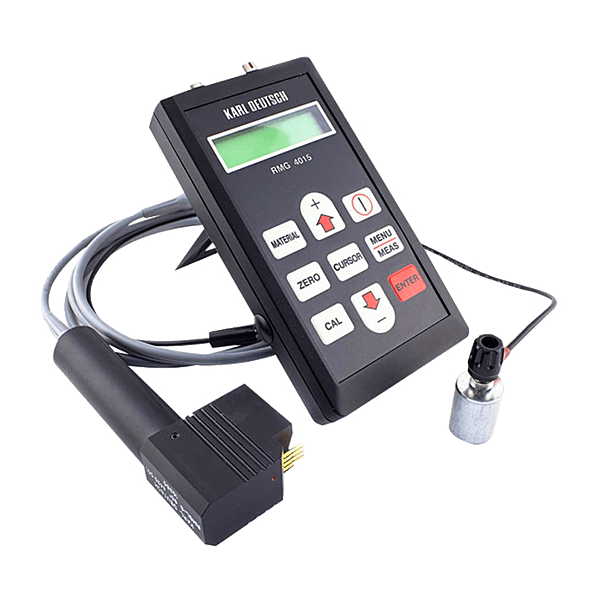
The Karl Deutsch RMG-4015 is a professional-grade, portable crack depth meter designed for fast, reliable, and non-destructive measurement of surface crack depths in metallic components. Built on the AC Potential Drop (ACPD) method and backed by decades of Karl Deutsch engineering expertise, this instrument transforms what was once an uncertain and complex measurement process into a straightforward, user-friendly procedure that delivers accurate results in the field or on the shop floor.
The RMG-4015 is always recommended when, for larger or expensive workpieces, reworking is needed, or when crack growth — such as in production lines — has to be monitored.
How It Works — The ACPD Measurement Principle
Crack depth determination by means of the potential probe method is based on the measurement of electrical resistance between two points on the surface of a metallic workpiece.
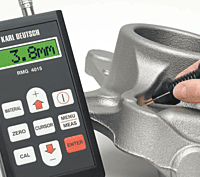
A probe with four spring-loaded and gilded contact pins is positioned across the crack to be measured on the workpiece. A constant alternating current is passed via two of the pins into the workpiece, while the two other pins measure the voltage drop across the crack — from which the crack depth is derived. The AC method utilizes the skin effect, which forces the current flow to the surface of the conductor and therefore follows the contour of the crack.
An additional advantage: due to low pulsed current, the required result is achieved and possible burnt contact spots on the specimen can be avoided. The operation and measured value formation are monitored by the microprocessor of the gauge — meaning incorrect handling or faulty measurements caused by wrong attachment or imperfect contacts are not possible.
Oblique & Inclined Crack Measurement
Real-world inspections often reveal cracks that don't run perpendicularly to the surface. In addition to common perpendicular cracks, the RMG-4015 features an additional measuring function for the determination of oblique cracks, which permits determining the inclination of the crack with respect to the material surface. The measurement is executed by means of a special four-pin probe, which permits connecting an external current pole that can be positioned left and alternatively right to the crack. Via the differences of the readings and the crack depth measured, the meter reliably determines the inclination and the projection perpendicularly to the surface.
This makes it possible to decide whether post-treatment of a cracked workpiece is technically feasible and economically justified.
Calibration — Flexible and Precise
The RMG-4015 offers multiple calibration methods to suit different inspection scenarios:
In the simplest case, it is sufficient to execute a comparison measurement at a crack-free spot of the specimen. Higher precision is achieved by means of a comparison measurement at a reference notch with a depth close to the expected crack depth. A multiple-point calibration over reference notches with varying depths covering the whole measuring range leads to the best results.
The multipoint material correction function permits the customer to acquire an individual material characteristics curve — which exactly meets the specimen under test and is permanently stored in the device — simply by creating test pieces fitted with saw cuts of different depths.
Advanced Probe Technology
Four decades of experience and continuous development in crack depth gauging have led to Karl Deutsch's most recent innovations in probe design. A straight probe and an angled version are available. The straight-type probe has a square-shaped arrangement of the contact pins, which allows for measurement on very small or strongly curved surfaces.
Two outer contact pins introduce a controlled alternating current into the material being tested, while the two inner pins precisely measure the resulting voltage drop across the crack. The RMG-4015 then uses this voltage drop to calculate and display the crack depth based on the material's electrical properties.
Current and measuring poles consist of spring-loaded, tip-hardened, and gilded contact pins — guaranteeing optimum electrical contact and requiring low attachment pressure only.
Key Specifications
| Parameter | Details |
|---|---|
| Measuring Range (Steel/Iron) | 0 – 99.9 mm |
| Measuring Range (Al, Cu, Brass) | 0 – 12 mm |
| Measurement Method | AC Potential Drop (ACPD) |
| Serial Interface | RS232C (4800 baud, 8 data bits, 1 stop bit, no parity) |
| USB Adapter | Available |
| Power | Battery-operated |
| Form Factor | Handheld / Portable |
Compatible Materials
The RMG-4015 measures crack depths on workpieces made of steel, iron, and austenite, and can also be used for cracks on copper, brass, aluminium, and most non-ferrous metals.
Data Management
The RS232C interface allows for transfer of measurement data to a printer or PC. A USB adapter is also available. Compatible with iCOM — Karl Deutsch's data management software — where data from several instruments can be transferred, stored, and further processed.
Ideal Applications
- Non-destructive testing (NDT) in manufacturing and quality control
- Evaluation of crack severity before reworking costly components
- Monitoring crack growth in production environments
- Supplement to Magnetic Particle Testing (MPI) and Penetrant Testing (PT) — used to evaluate the extension, orientation, or inclination angle of a crack to support rework decisions
- Aerospace, automotive, oil & gas, and heavy industry inspections