
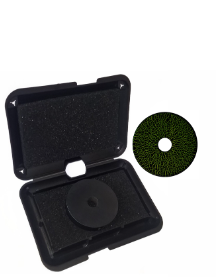
NM01EQPT5802
Reference Block Type 1 (MTU-3). Network of natural coarse and fine cracks, IAW ISO: 9934-2 SKU: EQPT-5802
Choose Quantity
Reference Block Type 1 (MTU-3) — Magnetic Particle Inspection Reference Block
Network of Natural Coarse & Fine Cracks | In Accordance with ISO 9934-2SKU: EQPT-5802
Overview
The Reference Block Type 1 (MTU-3) is the industry-standard performance verification and sensitivity monitoring tool for Magnetic Particle Inspection (MPI) — an essential quality control accessory for every fluorescent and visible magnetic particle testing operation. Manufactured in strict accordance with EN ISO 9934-2 (Annex B), this permanently magnetized steel disc features a unique, naturally occurring network of both coarse and fine surface cracks on both faces, providing a realistic and challenging test surface for verifying the performance of magnetic particle suspensions, dry powders, lighting environments, and overall system sensitivity.
Unlike reference blocks with artificial or machined notches, the MTU-3's crack pattern is produced by a controlled metallurgical treatment — hardening of a high-manganese, vanadium-alloyed steel disc — which generates authentic, naturally grown surface cracks that closely replicate the types of discontinuities encountered in real-world inspection scenarios. Each MTU-3 block has a completely unique crack pattern, and every block is supplied with a certificate and reference photograph showing the expected crack indication image when tested under optimal conditions — providing the inspector with a direct, objective baseline for comparison during daily system checks.
What's Included
| Item | Details |
|---|---|
| Reference Block Type 1 (MTU-3) | Permanently magnetized steel disc — both faces with natural crack network |
| Certificate | Conformance certificate per EN ISO 9934-2 |
| Reference Photograph | Image of expected crack indications under optimal test conditions |
Key Specifications
| Parameter | Details |
|---|---|
| Designation | Reference Block Type 1 / MTU Test Block No. 3 |
| Standard | EN ISO 9934-2:2002 (Annex B, Page 15, Figure B.1) |
| Material | High-manganese steel alloyed with vanadium |
| Form | Disc with central hole |
| Diameter | 50 mm (1.97 in) |
| Thickness | 10 mm (0.39 in) |
| Crack Type | Natural — coarse (grinding/sanding cracks) and fine (tension cracks) |
| Crack Size Range | 0.1 to 1 µm |
| Crack Surfaces | Both faces of the disc |
| Magnetization | Permanent — magnetized via central hole using central conductor technique |
| Crack Pattern | Unique per block — no two blocks are identical |
| Compatible Particles | Fluorescent and visible (colored) magnetic particles |
| Compatible Carriers | Wet suspension (oil or water-based) and dry powder |
| Supplied With | Certificate + reference photograph |
Box Dimensions & Shipping Weight (Estimated)
| Parameter | Metric | Imperial |
|---|---|---|
| Length | 152 mm | 6.0 in |
| Width | 127 mm | 5.0 in |
| Height | 76 mm | 3.0 in |
| Dimensions (L × W × H) | 152 × 127 × 76 mm | 6.0 × 5.0 × 3.0 in |
| Weight | 0.45 kg | 1.0 lb |
Dimensions and weight are estimates based on typical packaging for MPI reference block units of this class. Please verify with your freight forwarder prior to shipping.
Two Types of Natural Cracks — One Block
The MTU-3 reference block contains two distinctly different crack populations on each face, providing a simultaneous sensitivity test across a wide range of crack sizes:
- Coarse cracks (grinding/sanding cracks) — larger surface-breaking discontinuities that should be clearly revealed even by a degraded or partially contaminated magnetic particle suspension. Failure to reveal coarse indications is a clear signal that the inspection medium has failed and must be replaced immediately.
- Fine cracks (tension cracks) — smaller, more tightly closed discontinuities that are only revealed when the magnetic particle suspension is at full performance — correct concentration, undegraded particles, clean carrier fluid, and adequate UV-A or white light intensity. Inability to resolve fine crack indications signals marginal system performance that requires investigation before inspection proceeds.
Together, these two crack populations give the inspector an immediate, visual assessment of system performance across the full sensitivity range — from gross system failure to subtle performance degradation.
How to Use the MTU-3 Reference Block
- Ensure the block surface is clean and free from dust, oil, dried particles, and other contaminants before testing
- Apply the magnetic particle suspension or dry powder to both faces of the block using the same method and timing as the actual inspection process — spray time should match the cycle time set on the inspection unit
- After application, stand the block vertically on an absorbent cloth to allow excess liquid to drain off
- Inspect the crack indication pattern under the appropriate lighting conditions — UV-A lamp for fluorescent particles, white light for visible particles
- Compare the observed indication pattern against the supplied reference photograph
- If the observed indications match the reference photograph, system performance is confirmed — proceed with inspection
- If indications are significantly weaker or finer cracks are absent, investigate the cause — check particle concentration, particle condition, carrier fluid contamination, and lighting intensity before proceeding
- Clean the block immediately after use with an appropriate solvent cleaner — magnetic powder residue left on the surface for any length of time may cause permanent indications that will invalidate the reference block
Why Daily System Checks Matter
ISO 9934-2 and most industry MPI procedures require that the complete magnetic particle inspection system — including the inspection medium, lighting, and equipment — be verified at the start of each inspection shift and whenever there is any reason to suspect a change in system performance. The MTU-3 reference block is the primary tool for performing this check quickly, objectively, and in accordance with the applicable standard.
Specifically, the MTU-3 is used to:
- Verify magnetic particle suspension concentration — confirm that the particle concentration in the bath is within the specified range for reliable indication formation
- Detect bath contamination — identify contamination of the carrier fluid with oil, water, dirt, or other materials that can suppress indication formation or cause false indications
- Assess particle degradation — magnetic particles degrade over time through mechanical agitation and chemical exposure; the MTU-3 reveals when particle performance has dropped below acceptable levels
- Verify UV-A or white light intensity — inadequate lighting prevents fine indications from being seen; a system that cannot reveal fine cracks on the MTU-3 may be under-lit
- Confirm overall system readiness — a single, objective test that confirms all components of the MPI system are functioning correctly before inspection begins
Compliance & Standards
The MTU-3 Reference Block Type 1 is manufactured and tested in accordance with the following standards:
- EN ISO 9934-2 — Non-destructive testing: Magnetic particle testing — Part 2: Test equipment (Annex B)
- ASTM E709 — Standard Guide for Magnetic Particle Testing
- ASTM E1444 — Standard Practice for Magnetic Particle Testing
- ASME Boiler & Pressure Vessel Code — Section V, Article 7
Ideal Applications
- Daily system sensitivity verification at the start of each MPI inspection shift
- Magnetic particle suspension concentration and bath condition monitoring
- Fluorescent MPI system performance verification — UV-A lamp output and particle sensitivity
- Visible (colored) MPI system performance verification
- Quality control in magnetic particle inspection test benches and automated MPI systems
- Aerospace, oil and gas, pressure vessel, shipbuilding, and structural fabrication MPI operations
- Any MPI application governed by EN ISO 9934-2, ASTM E709, or ASTM E1444