
NM01OW3770
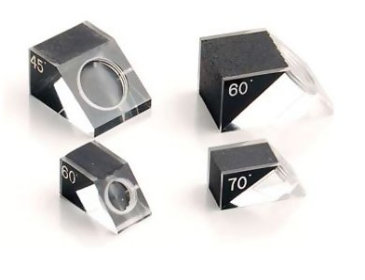
Quick Change Wedge, 0.375", 70°, OKO-NDT "70° ONLY"
Choose Quantity
The Quick Change Wedge, 0.375", 70°, "70° ONLY" is a precision accessory used in conjunction with specific ultrasonic straight beam transducers to perform angle beam inspection. It is a vital component in non-destructive testing (NDT) to introduce shear waves into a material at a defined angle, enabling the detection of flaws that are not perpendicular to the test surface.
Note: The manufacturer for this specific quick-change wedge is not provided. "Quick Change" wedge systems are typically proprietary to a particular ultrasonic equipment manufacturer (e.g., Olympus, GE Inspection Technologies/Baker Hughes, Sonatest, Dakota, Krautkramer, etc.). Compatibility is crucial, as wedges from one manufacturer's quick-change system usually do not fit another's.
Key Features & Benefits:
Quick Change System Compatibility: The primary advantage of a "quick change" wedge is its design, which allows for rapid and easy interchanging of wedges without needing to remove or re-mount the ultrasonic transducer from its dedicated holder or shoe. This significantly improves inspection efficiency when multiple angles or applications are required.
70° Refracted Angle: This wedge is designed to produce a nominal 70-degree shear wave in steel (when used with a standard straight beam transducer). A 70° angle is particularly useful for:
Detecting flaws that are oriented at steep angles to the inspection surface.
Inspecting thin-walled components or thin sections.
Examining weld roots or specific weld geometries where a steeper angle provides better acoustic coupling or defect detection.
Identifying near-surface defects that might be missed by shallower angles.
0.375" Compatible Transducer/Element Size: This dimension typically refers to the diameter or width of the straight beam transducer element that this wedge is designed to pair with. It ensures proper acoustic coupling and alignment between the transducer and the wedge's contact face.
Precision Machined Angle: Wedges are precisely machined to ensure accurate and repeatable refracted angles, which is critical for reliable defect localization and characterization in ultrasonic testing.
Durable Material Construction: Wedges are commonly made from durable plastic materials such as acrylic (Plexiglas) or polystyrene (Rexolite). These materials offer good acoustic properties and wear resistance for prolonged use in industrial environments.
Replaceable Wear Face: While not explicitly stated, many high-quality wedges include a replaceable wear face or are designed to be cost-effectively replaced when the contact surface becomes worn from repeated use.
Enhances Transducer Versatility: By pairing with various angle wedges, a single straight beam transducer can be adapted for a multitude of angle beam inspection tasks.
Specifications (Typical):
Type: Quick Change Angle Beam Wedge
Nominal Refracted Angle (in steel): 70°
Compatible Transducer Element Size: 0.375 inches (e.g., 0.375" diameter or 0.375" square element)
Wedge Material: Typically Acrylic, Polystyrene (Rexolite), or similar acoustically suitable plastic.
Acoustic Mode: Generates Shear Waves
Couplant Compatibility: Designed for use with standard ultrasonic couplants.
Application: Angle beam ultrasonic flaw detection in various materials.
Typical Applications:
Weld Inspection: Detecting cracks, lack of fusion, and other discontinuities in weld zones, particularly in thinner materials or specific joint configurations.
Crack Detection: Identifying service-induced cracking (e.g., fatigue cracks, stress corrosion cracks) in components.
Corrosion Mapping: While primarily for flaw detection, angle beam can sometimes complement straight beam for certain corrosion profiles.
Adhesive Bond Inspection: Assessing bond integrity in layered materials.
General Flaw Detection: In various materials and geometries where a high-angle shear wave is required.